One of the group's latest paper titled Highly selective and stable CO2 reduction to CO achieved by a graphitic carbon nitride/carbon nanotube composite electrocatalyst published in Chemistry - a European Journal gets a highlight in the ChemistryViews, the ChemPubSocEurope magazine. The paper presents the development of a novel CO2 reduction electrocatalyst achieved by covalently attaching graphitic carbon nitride (g-C3N4) onto multiwall carbon nanotubes (MWCNTs). The composite catalyst is prepared using cost-effective starting materials via a simple and scalable preparation approach of co-precipitation followed by polycondensation. The as-prepared composite is able to reduce CO2 exclusively to CO with a maximum Faraday efficiency of 60 %, and no decay in the catalytic activity was observed even after 50 h of reaction. The high catalytic activity of the composite was attributed to its active nitrogen-carbon sites, an enlarged Brunauer-Emmett-Teller surface in comparison to the individual materials, as well as improved conductivity.
Read more in: Highly Selective and Stable Reduction of CO2 to CO by a Graphitic Carbon Nitride/Carbon Nanotube Composite Electrocatalyst,
Xunyu Lu, Tze Hao Tan, Yun Hau Ng, Rose Amal,
Chem. Eur. J. 2016. DOI: 10.1002/chem.201601674
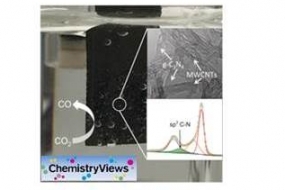
A cost effective electrocatalyst composed of g-C3N4 and MWCNTs for CO2 reduction