Studies showed that the Au/TiO2 has excellent potential in heterogeneous catalytic oxidation reactions due to localised surface plasmon resonance effect in the visible and spectral ranga of solar irradiation. In our previous work, we postulated that the photoenhancement of Au/TiO2 under UV illumination was due to the synergistic roles of photo- and thermocatalysis, while photoenhancment under visible light was solely due to plasmonic mediated charge transfert form the Au deposits to the TiO2 support.
In this newly published work in ACS Catalysis, we try to elucidate the mechanism and to understand the fundamental impacts of visible and UV photoexcitation on the dynamics of gas phase ethanol oxidation, using an insitu DRIFTS. Key findings from the study include (1) discovery of exclusive oxalate species, a critical precursor to C−C cleavage, which is also an indicator of selective ethanol adsorption at the Au−TiO2 interfacial perimeter, (ii) fortification of C−C bond cleavage by Au/TiO2 via detection of single-carbon species such as formate and carbon monoxide on Au/TiO2 in the dark under visible light illumination, (iii) validation of previous postulations regarding ethanol adsorption on TiO2 followed by oxygen activation at the Au−TiO2 interfacial perimeter, and (iv) in situ re-enactment of the different impacts by bandgap photoexcitation and plasmonically mediated charge transfer, under UV and visible light illumination, respectively, on ethanol oxidation by Au/TiO2 and neat TiO2.

Read more in ACS Catalysis, 2016; DOI:10.1021/acscatal.6b01833
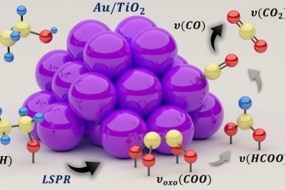
Schematic illustration describing the photothermal oxidation of Ethanol by Au/TiO2 with associated electron transfer