This paper examined the impact of the reducible mixed oxides of titanium with cerium properties as a support for nickel-catalysed low temperature steam reforming of methane. The authors were utilising different synthesis routes, namely sol-gel and flame spray pyrolysis to produce mixed oxide supports of varying composition of cerium and titanium. The sol-gel-prepared supports exhibited improved methane conversion rates with an increased presence of cerium within the support while the catalysts with flame-made supports demonstrated poor stability upon incorporation of cerium at certain ratios. Despite the consistent high surface area and fine nickel dispersion across all flame-synthesised supports, the findings revealed that while these attributes are beneficial for steam reforming catalysis, they do not necessarily assure effective conversions. In addition to the above qualities, the sol-gel-synthesised materials demonstrated that crystalline features of the support also play a vital role in maintaining stable conversions at 500 °C.
Read more in App. Cat A, 2017, 530, 111-124
Check out our other articles on low temperature steam reforming of methane:
- Lovell EC; Fuller A; Scott J; Amal R, 2016, 'Enhancing Ni-SiO2 catalysts for the carbon dioxide reforming of methane: Reduction-oxidation-reduction pre-treatment', APPLIED CATALYSIS B-ENVIRONMENTAL, vol. 199, pp. 155 - 165, http://dx.doi.org/10.1016/j.apcdtb.2016.05.080
- Kho ET; Scott J; Amal R, 2016, 'Ni/TiO2 for low temperature steam reforming of methane', Chemical Engineering Science, vol. 140, pp. 161 - 170, http://dx.doi.org/10.1016/j.ces.2015.10.021
- Lovell EC; Scott J; Amal R, 2015, 'Ni-SiO2 catalysts for the carbon dioxide reforming of methane: Varying support properties by flame spray pyrolysis', Molecules, vol. 20, pp. 4594 - 4609, http://dx.doi.org/10.3390/molecules20034594
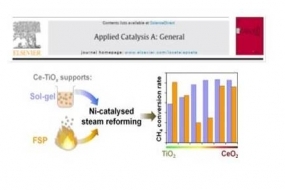
Ceria-titania support crystallinity is identified to be another key aspect towards effective nickel-catalysed low temperature steam reforming of methane.