The anatase-rutile mixed-phase photocatalysts have attracted extensive research interest due to the superior activity compared to their single-phase counterparts. In this study, doping of Sn4+ ions into the lattice of TiO2 facilitates the phase transformation from anatase to rutile at a lower temperature while maintaining the same crystal sizes compared to the conventional annealling approach. The mass ratios between anatase and rutile phases can be easily manipulated by varying the Sn-dopant content. Characterization results reveal that the Sn4+ ions entered the lattice of TiO2 by substituting some of the Ti4+ ions and distributed evenly in the matrix of TiO2.
The substitution induced the distortion of the lattice structure, which realized the phase transformation from anatase to rutile at a lower temperature and the close-contact phase junctions were consequently formed between anatase and rutile, accounting for the efficient charge separations. The mixed-phase catalysts prepared by doping Sn4+ ions into the TiO2 exhibit superior activity for photocatalytic hydrogen generation in the presence of Au nanoparticles, relatively to their counterparts prepared by the conventional annealling at higher temperatures. The band allignment between anatase and rutile phases is established based on the valence band X-ray photoelectron spectroscopic spectra and diffuse reflectance spectra to understand the spatial charge separation process at the heterojunction between the two phases. The study provides a new route for the synthesis of mixed-phase TiO2 catalysts for photocatalytic applications and advances the understanding on the enhanced photocatalytic properties of anatase-rutile mixtures.
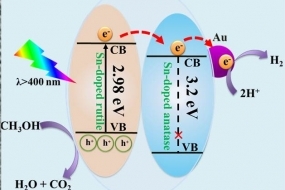
Graphical abstract for Sn-doped anatase-rutile composite photocatalysts were prepared by a simple evaporation-induced self-assembly method for efficient hydrogen production under visible light irradiation.