Our invited article on solar water splitting is now published in J. Mater. Chem. A as part of the themed issue highlighting 2016's rising researchers in materials chemistry research. The themed issue is named: EMERGING INVESTIGATORS 2016: Novel Design Strategies for New Functional Materials. This paper reports a new method to prepare a ternary oxide thin film from a simple oxide. The synthesis strategy involved subjecting a MoO3 thin film, prepared by anodising a Mo foil, to hydrothermal treatment in the presence of a bismuth salt solution. The new approach removes the need for preformed particles to prepare the film, in turn providing a robust and stable anode for PEC water splitting.
Transforming the surface MoO3 into Bi2MoO6 to construct the Bi2MoO6/MoO3 composite electrode leads to an improvement in photoelectrochemical (PEC) performance. The Bi2MoO6/MoO3 electrode exhibited a 79% enhancement in anodic photocurrent density compared to the unmodified MoO3 thin film under a positive bias of 0.4 V vs. Ag/AgCl. The better performance was attributed to: (i) the narrow optical band gap of Bi2MoO6, which extended the absorption of light by the film into the visible range and (ii) the well-aligned band structure of MoO3 and Bi2MoO6. The Bi2MoO6/MoO3 thin film electrode was subsequently utilised as a photoanode for PEC water splitting. The Bi2MoO6/MoO3 thin film electrode provided close to 100% faradic photocurrent-to-O2 conversion efficiency for PEC water splitting under UV illumination and, importantly, exhibited excellent photostability as a consequence of the unique synthesis method.
Read full paper: J. Mater.Chem.A (2016) Advanced Article doi:10.1039/C6TA00700
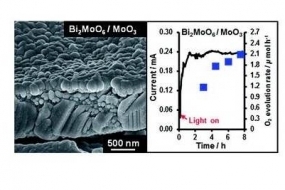
J.Mater.Chem.A (2016), Advance Article, doi:10.1039/C6TA00700G