The new published article in Chemical Engineering Science demonstrate the suitability of employing TiO2 as a support for nickel metal catalyst for low-temperature steam reforming of methane (SRM). SRM technology remains the most practical and feasible process for large scale Hydrogen production. One of its drawback of SRM is the high temperature requirement of SRM which demands large energy consumption. To achieve a more sustainable route to hydrogen production, the harnessing of renewable solar energy to provide for the heat demand is ideal. A simpler, delocalised solar reforming units which operate at a lower temperature would lead to cheaper operating costs and extending life of catalyst.
Studies on TiO2 as a catalyst support have pointed towards its potential benefits, where it has the advantages of being a reducible oxide, thus providing unique electronic interactions between the metal and support under milder reaction temperature conditions. Accordingly, the work presented here investigates the suitability of TiO2 as a catalyst support for low-temperature SRM. The metal catalyst used in the study was nickel as it is used in the commercial SRM process and presents a balance between cost and performance. By applying a mild pre-treatment temperature (400 °C), the interactive properties between nickel and the TiO2 support were initiated without introducing excessive strong metal–support interactions that could promote inactivity. The presence of metal–support interaction in Ni/TiO2 was evident when compared with an inert oxide support such as SiO2. The Ni/TiO2 catalyst was shown to be capable of maintaining stable conversions and product selectivities for at least 96 h, depending on the H2O/CH4 feed ratio.
Full paper is available from: Chem Eng Science, vol 140, 161-170
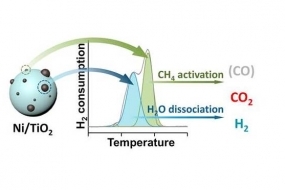
Graphical abstract showing Ni/TiO2 catalyst for low-temperature SRM