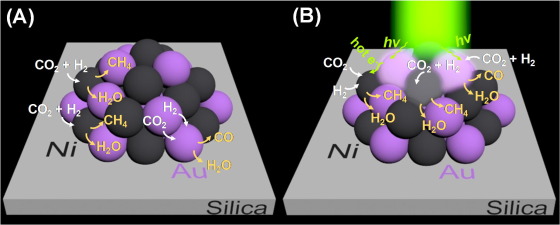
The study recently published in Chem. Eng. Science, is aiming to explore the effect of plasmonic enhancement to the role of Ni-Au bimetallic catalysts for CO2 reduction and methanation. Lovell, et. al, use laser light illumination of 520n, and 660nm on Ni-Au/SiO2 over a temperature range of 150 °C to 450 °C, while measuring the CO2 conversion along with CH4 and CO selectivity to assess the catalytic performance.
The result showed that under laser light illumination, at 520 nm and 450 °C, CO2 conversion for Ni–Au/SiO2 increased by 79% whilst simultaneously lowering CH4 selectivity, which was attributed to localised surface plasmon resonance effects and promotion of the reverse water-gas shift reaction by the Au. While laser light illumination at 660 nm also introduced a mild conversion increase, however not to the same extent as for 520 nm.
Using XPS, the monometallic Ni and Au samples were examined and compared with the bimetallic system to elucidate the origin of the photo enhancement and to understand the plasmonic and catalytic interactions. The Au/SiO2 and Ni/SiO2 samples demonstrated that the photo-enhancement arose from the presence of the Au, with the increase in CO2 conversion at 520 nm increasing with increasing Au content; Au (∼110%) > Ni-Au (∼80%) > Ni (∼21%).
Read full article in Chem. Eng. Sci., 2018, in press (doi: https://doi.org/10.1016/j.ces.2018.04.003)

Schematic representation of conversion and selectivity of Ni-Au/SiO2 under light illumination