In this work, Tan, et.al exploited the redox functional {010} and {110} facets on BiVO4,[11b] which is a promising visible-light-responsive semiconductor active for oxygen evolution from water and organic degradations. They demonstrated the presence of an increased surface area of {010} facets relative to that of {110} facets expedites electron transfer from BiVO4 to graphene. The more pronounced photocurrent density in conjunction with improved charge transfer ability of RGO incorporated with BiVO4 of larger {010}/{110} relative exposure extent strongly signifies the constructive role of {010} facets in facilitating the interfacial charge transfer in graphene/BiVO4 composite.
The reported findings are supported by the Density Functional Theory (DFT) calculations which showed that due to the smaller Schottky barrier, higher interface binding energy, and metallic nature at the interface, charge is easier to be transported from {010} facets of BiVO4 to graphene than from {110} facets.
Read more in SMALL 2016 (DOI:10.1002/smll.201601536)
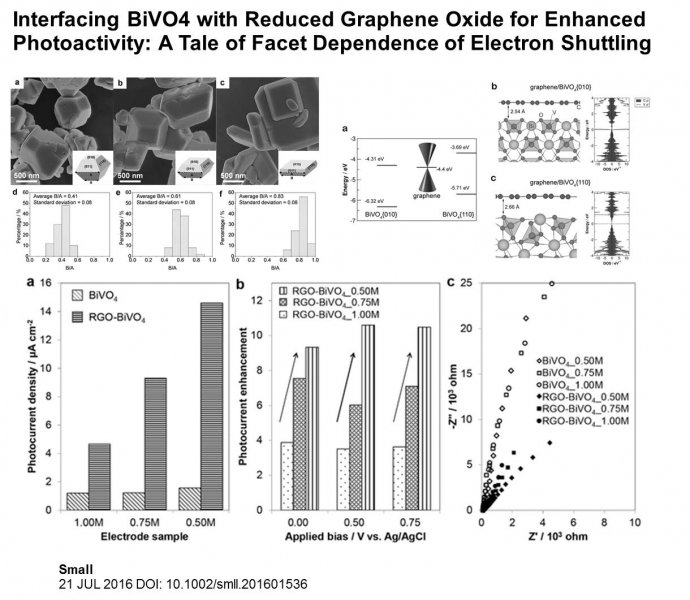
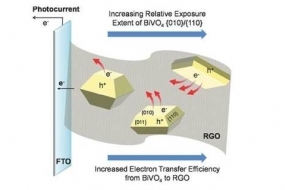
Extended exposure of {010} facets relative to {110} is elucidated to facilitate electron transfer from BiVO4 to reduced graphene oxide