Studies has shown that photogenerated electrons and holes can be directed toward specific crystal facets of a semiconductor particle, which is believed to arise from differences in their surface electronic structures, suggesting that different facets can act as either photo-reduction or photo-oxidation sites.This paper examines the propensity for this effect to occur in faceted, plate-like bismuth molybdate (Bi2MoO6), which is a useful photocatalyst for water oxidation. Photo-excited electrons and holes are shown to be spatially separated toward the {100} and {001}/{010} facets of Bi2MoO6, respectively, by facet-dependent photo-deposition of noble metals (Pt, Au and Ag) and metal oxides (PbO2, MnOx and CoOx). Theoretical calculations revealed that differences in energy levels between the conduction bands and valence bands of the {100} and {001}/{010} facets can contribute to electrons and holes being drawn to different surfaces of the plate-like Bi2MoO6.
In view of the enhanced charge separation and photo-oxidation activity reported here, the rational manipulation of exposed crystal facets and the assembly of co-catalysts on certain facets can provide inspiration to design other highly-efficient photocatalyst systems.
Read more at ACS Applied Materials and Interface, 2018, doi 10.1021/acsami.7b17856
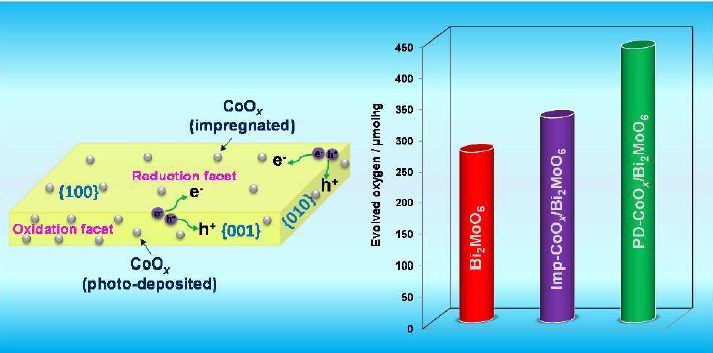
Proposed charge separation process within plate-like Bi2MoO6